


Tony’s Acoustic Challenge – The New Way to Learn Guitar › Family Forums › Community Support › I Can’t Play the G Chord
-
I Can’t Play the G Chord
Posted by pjmatthews3702gmail-com on May 14, 2024 at 12:28 pmAny suggestions? I have short fingers and no matter how close I have my palm to the neck of the guitar, they are all muffled when I( try to strum them. I keep trying to check by playing each string but just can’t get it. Thank you in advance.
jumpinjeff replied 1 year, 9 months ago 14 Members · 18 Replies -
18 Replies
-

You might find it easier to play on a smaller guitar (like a Baby Taylor). Also check out the finger exercises (think they were somewhere in the 30 day start program). Things won’t sound so good till you build up some calluses on your fingers, but it will happen for you if you don’t give up.
-

Guitar necks are manufactured with different width sizes. When I first started, I was using my husband’s guitar and it had a 2-inch neck. It wasn’t happening for me, so I purchased a youth guitar with a smaller neck width. It does make a difference. Since you’re a beginner, try to do simpler G chord and then build up to the one that Tony uses. The best thing is finger exercises and practice. You’ll find that the G chord will be easy as time goes on. The chords that will take months in getting will be the C & F chords (especially Barre). Short fingers and Barre chords are a nightmare so fair warning and don’t get frustrated – it seems to be a rite of passage with those chords. Luckily, there are work around until the fingers retain the muscle memory. Good luck!
-

One thing I do when I was learning the G Chord specifically is play one string of the sequence at a time. ie
First finger 2nd Fret, A string. play around with at one finger until you get the sound you are looking for and only play the A string so you can hear if you have it.
Next while keeping your first finger down because you now have that sounds place your middle finger on the 3rd Fret, E string and only play the E string until you have the sound you are looking for. Once you do then go back and forth between the two strings to make sure you have the sound you want.
Now go to the next finger while still holding the first finger and middle finger in place. Which was for me the ring finger. Put that one on the 3rd Fret, B string. Play around with just the ring finger and the B string until you get the sound you want. Once you do now play around with all 3 strings making sure you have nice clear sound.
Last is the Pinky 3rd Fret, high E string. Same routine.
Now once you get it strum for a bit to get the feel. Then here is what I did. I took all my fingers away like Toni showed in one exercise put my left hand which is my fretting hand on my thigh away from my guitar. Then tried to set myself up for the G Chord again. Now I had to do go through the process for a week or so until I started to get the feel of where my fingers needed to be and my wrist position that worked for me. Which I am like you short fingers. Mine are also thinker fingers as well which is another thing I had to learn to work around.
Now it’s just practicing that until you feel you have master the G Chord and can do it without looking at the fret board. Take your time and have fun with it. We all go through this.
-

Brandon–
I really like this response of yours. As I was reading down the responses in this thread, I was thinking of a response that would help. I was gonna mention “landing one finger at a time”…….. but then I read your response……… and yours nailed it perfectly.
I think a person’s hand and brain “find” the first note automatically, with the other fingers just finding their “order” also automatically– (after lots of repetition, of course!).
To PJ—— Remember that your fretting-fingers have to come from somewhere to get to their “G-chord positions”. Most of the time they will be coming FROM another chord TO that G-chord. If I were to offer one suggestion– it would be for you to consider learning your G-chord by transitioning TO it from another chord. Any other chord– it doesn’t matter.
There is no song with just one chord. Learning the transitions is equally as important as learning the chords just by themselves.
One possible second suggestion?…….. close your eyes.
theoldcoach
-
This reply was modified 2 years, 3 months ago by the-old-coach.
-
This reply was modified 2 years, 3 months ago by the-old-coach.
-
This reply was modified 2 years, 3 months ago by
-
-

In case you still need this, I thought I would reply.
You could try a simplified G chord. A teacher taught me to put the second finger (middle finger) on the A string, second fret, the third finger (ring finger) on the low E string, third fret, and the fourth finger (pinky finger) on the high E string, third fret. If that is still too much, you could omit the fourth finger (pinky) and not strum the high E until your fingers get stronger. Add it down the road, and the full G chord when you are ready. Then you can start having some fun!
Hope it helps!
-

Me too! I’m on my 4th week falling behind not because I’m trying to be perfect but my fingers are really struggling to play most of these cords. ha Em I got but the G & D are giving me fits! I practice every day 30+ minutes oh and my finger tips are tingly and numb. I will not give up but it’s hard on my short inflexible fingers. Ok I’m back to practice. Thanks for listening
-

I would encourage you to keep trying. The fingers will reach the strings powerfully with practice. Good luck.
-

Do not fear the D chord. My problem is the C chord. You are not alone. I just keep plugging along, but it slows my progress, so I watch the daily challenges and try them to see if they help with my troubles, which, most times, they really do. Short fingers unite LOL
-
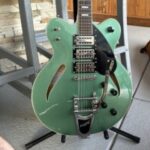
I switched out my acoustic for a Gretsch Semi-Hollow Body. The neck on the electrics seem thinner and smaller so chords are easier to make. Plus the Semi-Hollows can still be played unplugged and with a great tone. Plus take the finger stretch skill course. Its a life changer.
-
This reply was modified 2 years, 3 months ago by Gretsch_Convert.
-
This reply was modified 2 years, 3 months ago by
-

Thanks for this discussion, I just had an epiphany from it!
No more thud! – Small Wins – Tony’s Acoustic Challenge (tonypolecastro.com)

tonypolecastro.com
No more thud! - Small Wins - Tony's Acoustic Challenge
No more thud! - Small Wins - Tony's Acoustic Challenge
-

Thank you. Stopped playing for a while as I was getting really frustrated. Am starting up again after reading the great suggestions here.
-
-

Hi @pjmatthews3702gmail-com , For the time being while you stretch and work on your hand position and finger flexibility consider this: the three finger G chord we are taught is actually three G chords in one. Think of the three bass strings as one G chord ( Cover E and A strings appropriately for G chord) and then, the treble string G chord, covering the high E string only and playing the three bottom strings. There is another G chord and it is hidden because you don’t have to fret any strings but strike only the middle 3 strings open D,G,B strings. It is a full G chord. Three ways to make G chords all in the same place, add in the 3 finger G shape and there are 4. I hope one of these is a win for you. Keep working toward that which remains challenging but take a win with a easier G. (hint: down the road this concept will have tremendous effect, not just with G chords but with all the G shapes wherever you want to move them.) Give it a shot see if it works for you. Any questions? report back…we all can improve together.
-

Did you get the G chord down yet…if you still need help I can help you out here…
-
-
Well you may already know this one…but for years I made my G as follows I still gravitate towards it…I place my pointer on the A string 2nd fret…my middle on the top E string 3rd fret (6 string) and my ring finger on the bottom E string 3rd fret (1 string) and use my pinky for hammer ons etc. on the B string 3rd fret…
-

I use this G variation often. I still use the standard G shape however. I also sometimes play the A chord with my pinky, ring and middle finger leaving my index finger for chord enhancements.
-
Log in to reply.