
Guitar Notes: Everything a Beginner NEEDS to Know


Guitar notes … what are they, and why should you care?
Think of guitar notes as the written language for playing guitar. Everything from chords to melodies uses guitar notes.
Learning guitar notes will help you comprehend new music, hone certain guitar techniques, and communicate with other musicians more easily.
In this lesson, we will cover:
- Notes vs. chords
- The musical alphabet (so you can “write” the language!)
- Sharps and flats, and why they’re important
- Bonus theory along the way
Oh, snap…did I just say the “T” word?
Look, there’s just going to be a tiny bit of theory in this guitar notes lesson. I’ll keep it on the light side — I promise.
Now, if you’re looking for more of a framework of how to practice guitar, I have something for you.
First, if you’re still on the fence about online guitar lessons, I want you to know you’re not alone. While there are many benefits, the biggest problem with online guitar lessons is the overwhelm – but I can help with that.
Second, I want you to know about my guitar reboot workshop that I’m offering for free – to help you overcome your overwhelm. You can learn more about it by clicking here. If you’re someone who thinks guitar is hard to learn, I promise I can show you an easy way to break it down in a way that’s manageable, understandable, and fun.
All I’ll say for now is that this workshop has helped thousands of guitar players already…
Anyways, let’s dive into guitar notes 101…
Table of Contents
- Guitar String Notes for Standard Tuning
- Guitar Notes vs. Guitar Chords
- Guitar Notes in Relation to the Fretboard
- Naturals vs. Sharps and Flats
- Guitar Notes Exercise on the E String
- Taking 10 Minutes Every Day to Get Better
Guitar String Notes for Standard Tuning
Before you go any further, you need to familiarize yourself with guitar string notes. Without knowing the string names and notes, we won’t be able to learn any other guitar notes!
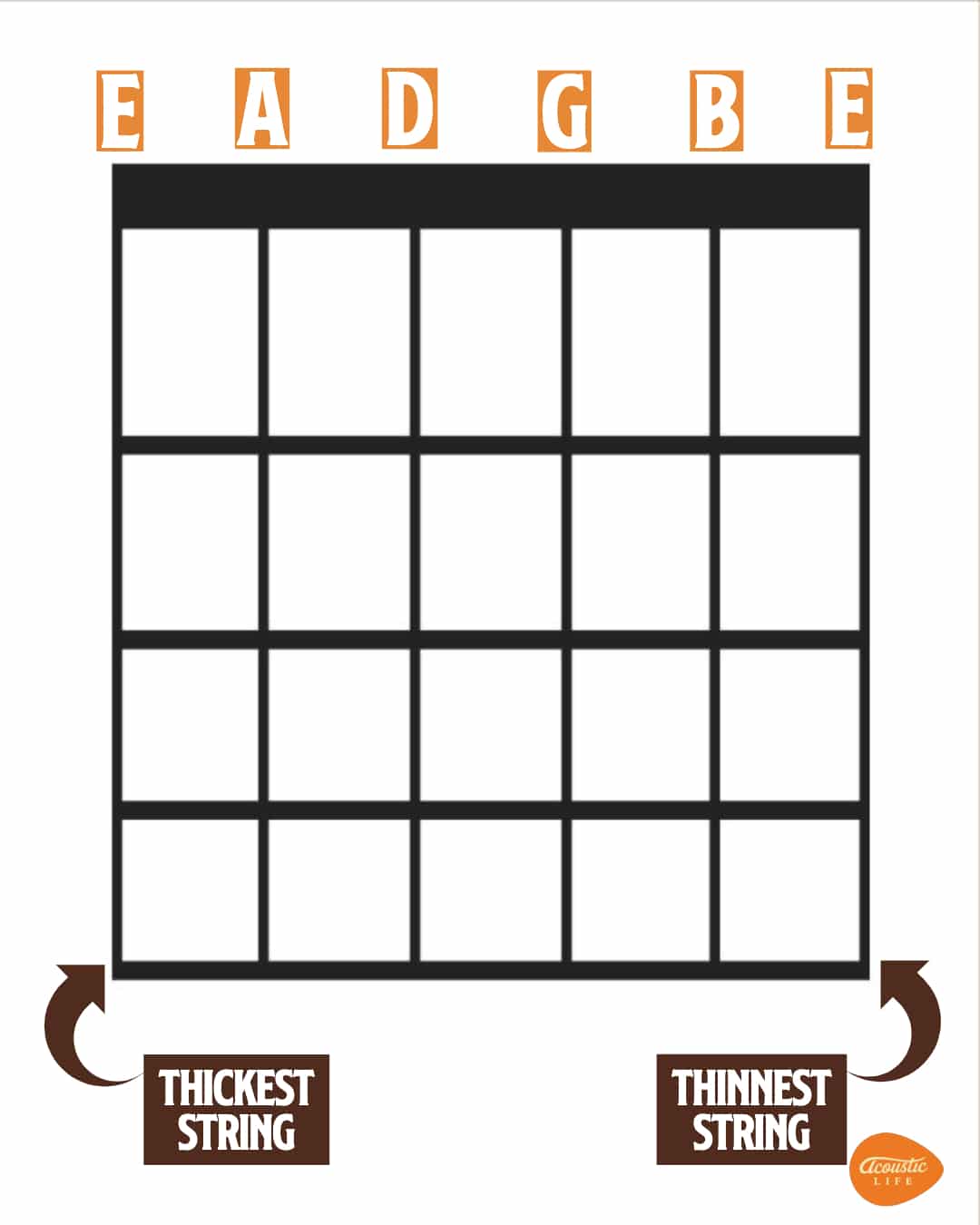
Most guitars have 6 strings, each with a different note. In standard tuning, and from low to high, the guitar string notes are: E, A, D, G, B, E. This is constant across different brands and guitar types. Whether you have a Gibson or a Martin, an Ibanez or Epiphone, the notes remain the same.
There are a few phrases you can use to remember each string name: Eddie Ate Dynamite, Good Bye Eddie, or, Elvis Always Dug Good Banana Eating.
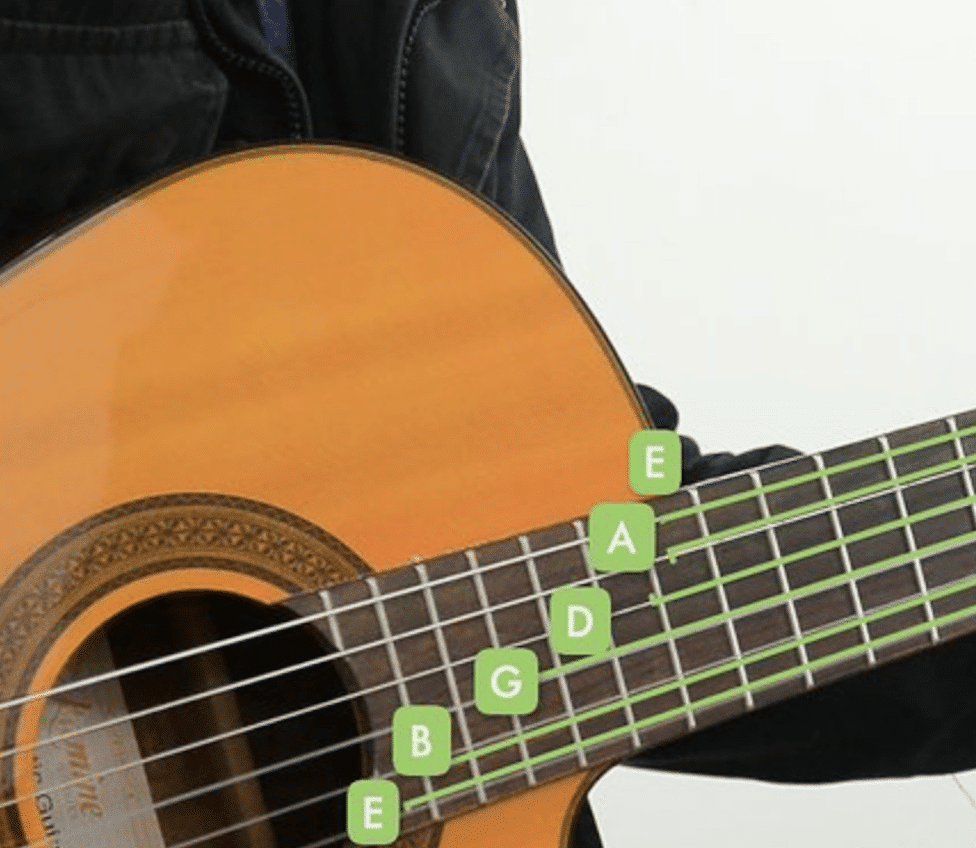
Notice that the strings are arranged from thickest (lowest note) to thinnest (highest note). There are plenty of other tunings, called alternate tunings (open C, open G, drop D, etc). For now, let’s stick with standard tuning.
Six Strings … Six Names
- The thickest string — the one that produces the lowest sound — is tuned to an E note. I’ll refer to this as the low E string so as not to be confused with the other E string.
- The next string, going thickest to thinnest, is tuned to an A note, which is why we call it the A string.
- The next string is tuned to a D note, and we’ll call that one the D string.
- After the D string is the G string, which (you guessed it) is tuned to a G note.
- The second-to-last string is tuned to a B note, which is why we call it the B string.
- The highest and thinnest string on the guitar is tuned to an E note. This E note is two times higher than your low E string. We call this string the high E string.
The Best Way to Remember Guitar String Notes
The best way to remember the guitar string notes and their names is to create a mnemonic device. Think of it as a way to help you remember which letters go where. From low to high, the guitar string notes are: E, A, D, G, B, E. So a good saying is: Eddie Ate Dynamite Good Bye Eddie.
Boom!
There are tons of different mnemonic devices you can use. Shoot, you can even try creating one yourself! Try to make it silly, memorable, and cogent.
Note: The guitar notes for the strings are the same whether you play electric, acoustic, rock, bluegrass, or metal — rock on!
Guitar Notes vs. Guitar Chords
To put it as simply as possible, let’s think about music as a language.
- A note is a single letter. It’s the smallest part of musical language.
- A chord is like a word: it’s made up of multiple notes.
To create a chord, we need a combination of notes grouped together.
Guitar Note Sound vs. Chord Sound
Guitar Notes
Just as a single letter on its own sounds different from a word, notes sound different from chords.
Guitar notes are individual pitches. For example, when you play one string at a time, you’re playing one note.
Here’s an example of some tablature. Check out these links to learn how to read guitar tabs, understand guitar tab symbols, as well as some acoustic guitar tabs for beginners.
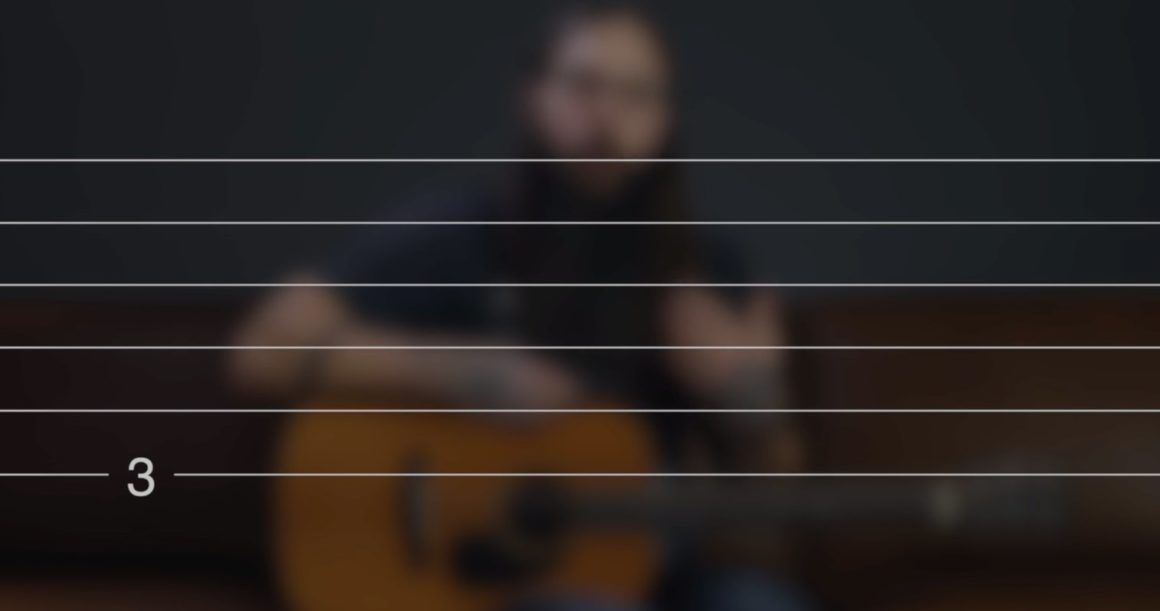
As you read the tab from left to right, notice how there’s only one note at a time. This is an example of single guitar notes.
Here’s a quick picture of all guitar notes:
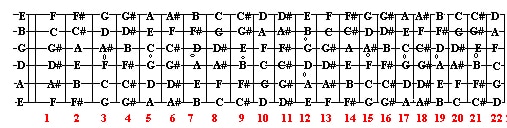
Chords
As we said earlier, chords are like words: you create a chord when you take notes and play many of them at once. There are also different types of chords; for example, ordinary chords and power chords. Check out my lesson if you want a quick rundown of chord diagrams!
Try playing this D chord.
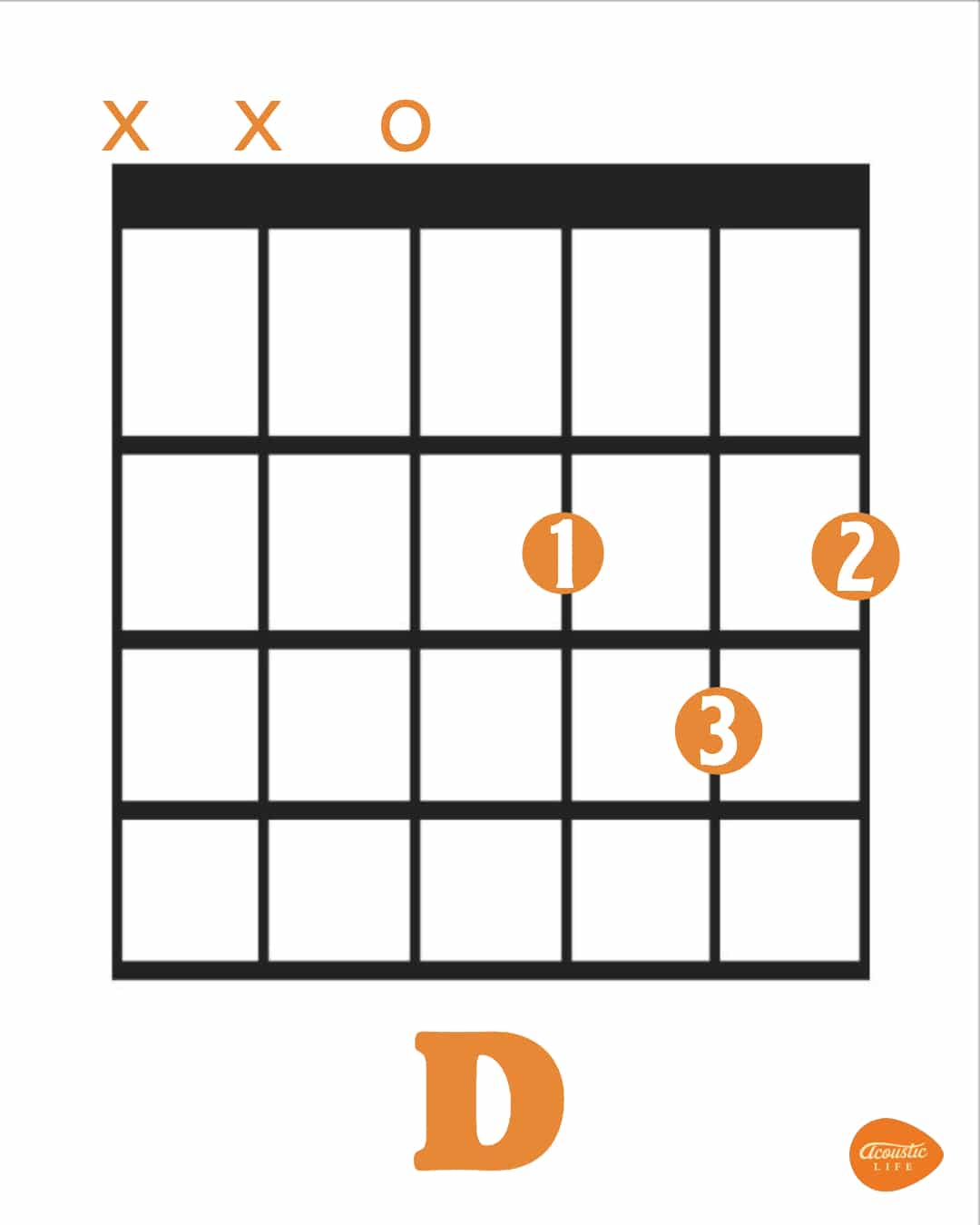
You strum all of the strings at once when you play the D chord. Every note is played at the same time to create the chord.
Chords have a richer, fuller sound than guitar notes. Check out this lesson to learn the most essential guitar chords for beginners.
Should You Learn Chords or Notes First?
I will never tell you what you can or can’t do. I think you should follow your creative impulses.
However…
It can be incredibly overwhelming when you first start playing guitar. I have a few suggestions to help process the barrage of information out there, but one thing is for sure…
DO NOT spend time memorizing where every single note is on the fretboard.
Instead, learn some basic guitar chords or scales you can apply to songs.
For example, try learning some power chords so you can play your first song, like “Louie Louie.”
If you want to work on guitar notes or solos, check out my lesson on how to solo on guitar – even over the blues (yes, I’ll explain the blues, too!). I also have lessons on how to finger pick and different strumming patterns you can try.
Why Chords Help You
Guitar notes can help you understand the fretboard and the music in general, but it is difficult to play songs just with guitar notes. Here’s why…
There are thousands of songs that use just three chords.
There are few songs where the single-note melody has just three notes.
Additionally, playing chords helps build your finger strength. As you play along with songs or in a jam group, you’ll build up your strength and be able to play for longer periods.
After you feel comfortable playing chords and understand time, rhythm, and musical structure, you can start dabbling in more theory and scales.
However, until you get to that point, playing chords is a great way to start playing the guitar.
Guitar Notes in Relation to the Fretboard
I will talk about the fretboard a little more to better understand guitar notes. While you don’t have to know the following information, it will deepen your understanding of the guitar.
If you’re ready to learn the musical alphabet and how guitar notes are arranged on the fretboard, let’s dive in!
Guitar Notes and Musical Alphabet
Let me clarify: guitars use the same musical alphabet as violins, flutes, basses, and saxophones.
The one difference is in looking at tablature, but that’s more of a musical notation style.
All instruments rely on a musical alphabet that creates a common language for all musicians. The good news is that the musical alphabet only uses 12 notes — unlike the English alphabet, which uses 26 letters!
Here’s one way we can write the musical alphabet:
A, A#, B, C, C#, D, D#, E, F, F#, G, G#, A
We can also write the musical alphabet this way:
A, Bb, B, C, Db, D, Eb, E, F, Gb, G, Ab, A
But what do the “#” and “b” signs mean?
First off, the “#” represents a ‘sharp.’ When you see, A#, you pronounce it as A sharp.
When you see the “b” sign after a note, the “b” represents a ‘flat’. It is pronounced, “A flat.”
Guitar Notes with Sharps or Flats
In short, sharps and flats are the same things. The difference lies in how you look at a note.
In the example where I wrote out two ways to talk about the musical alphabet, all letters without sharps or flats stayed the same. But for A#, the corresponding flat is Bb. This means that those two notes are the same.
Another way to think about this is about telling time. If it’s 7:30 a.m., you could say it is “30 ’til 8:00.” You could also say it’s “half-past 7:00.” They’re saying the same things in different ways.
- C# is the same note as Db
- D# = Eb
- F# = Gb
- G# = Ab
While I showed you two different ways of looking at the musical alphabet with all the guitar notes, you’ll most likely see the alphabet written with flats and sharps.
Notes without Sharps or Flats
Let’s look at the musical alphabet that uses all sharps again:
A, A#, B, C, C#, D, D#, E, F, F#, G, G#, A
Did you notice how there aren’t any sharps or flats between B and C, and E and F?
- In music, this is no note between B and C
- No note between E and F
- B#/Cb does not exist, nor does E#/Fb
These are the only cases where there aren’t flats or sharps that can be attached to notes. Instead, B# is essentially C. Never refer to C as Cb/B#.
Knowing the Fretboard and the Guitar Notes
As I’ve explained in other lessons, every fret on your guitar represents a guitar note. As each fret goes up by one number, you move up the musical alphabet by one space.
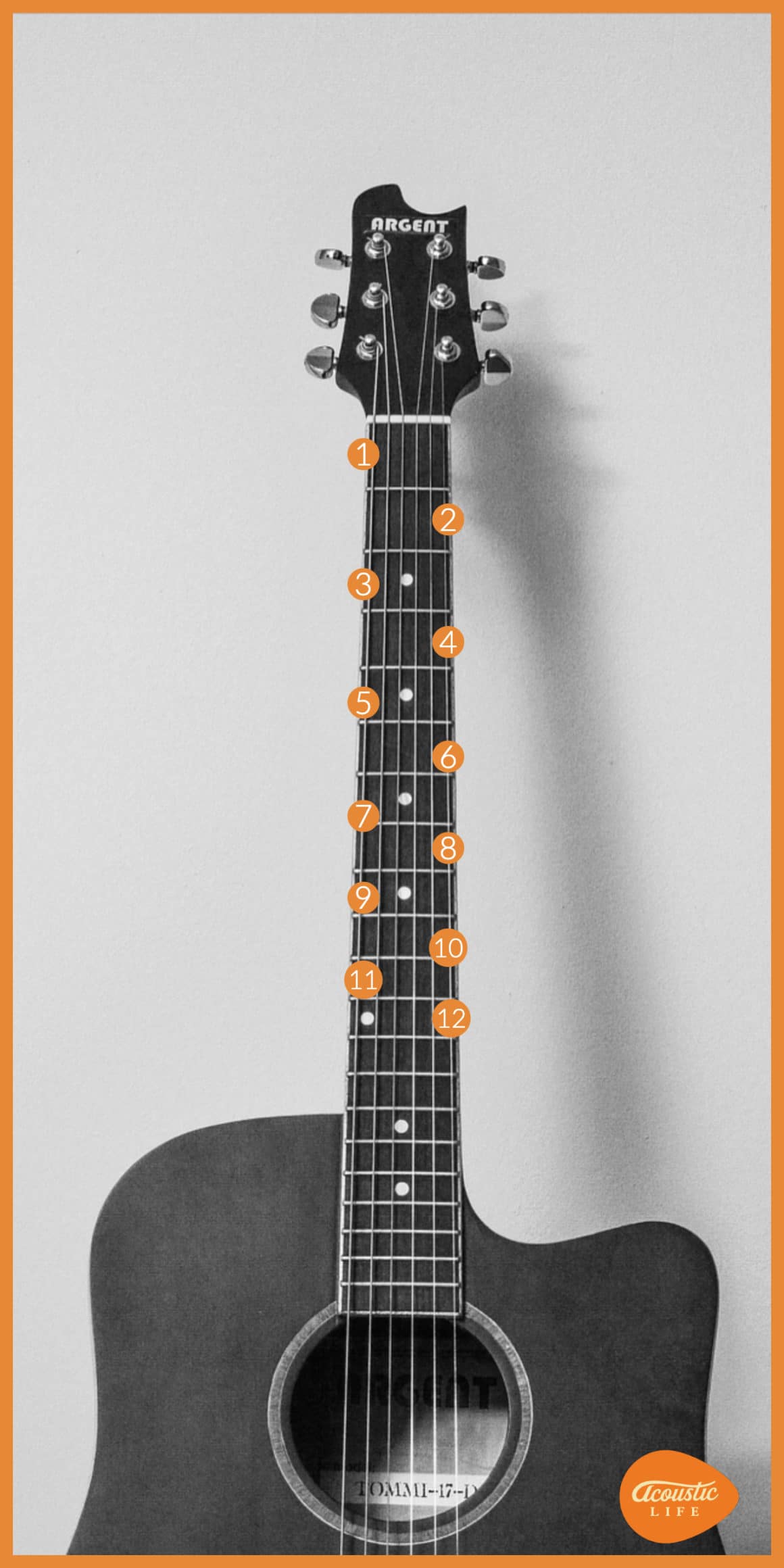
Think of the open string you pluck as starting at 0. From there, you move up one space in the musical alphabet.
If you pluck the low E string (the thickest string) and move up one fret, you’ll be playing an F note. Remember that there’s no sharp or flat note between E and F!
As you move up one fret at a time and pluck each guitar note, you’ll hear the pitch get higher as you move up the fretboard. Here’s the full order of notes you play if you go all the way to the 12th fret:
- E = open string
- F = 1st fret
- F# = 2nd fret
- G = 3rd fret
- G# = 4th fret
- A = 5th fret
- A# = 6th fret
- B = 7th fret
- C = 8th fret
- C# = 9th fret
- D = 10th fret
- D# = 11th fret
- E = 12th fret
Once you hit the 12th fret, you successfully played a full octave. In those 12 notes, you’ve played the entire musical alphabet!
Try descending and using flats as you feel comfortable thinking about ascending the guitar’s fretboard in sharps!
From the 12th fret down, the notes will be arranged like this:
- E = 12th fret
- Eb = 11th fret
- D = 10th fret
- Db = 9th fret
- C = 8th fret
- B = 7th fret
- Bb = 6th fret
- A = 6th fret
- Ab = 4th fret
- G = 3rd fret
- Gb = 2nd fret
- F = 1st fret
- E = open string
The reason why moving down the fretboard is difficult is because most people don’t know the alphabet in reverse!
Fortunately, you just need to become familiar with A-G, forward and backward.
If you want to help solidify your understanding of guitar notes in relation to the fretboard, try saying the notes out loud as you play them. So when you’re on the 5th fret of the low E string, you audibly say “A.”
Using Fret Markers as Anchors
You may have noticed that finding guitar notes high up the fretboard can feel disorienting. It’s almost like having fretboard vertigo!
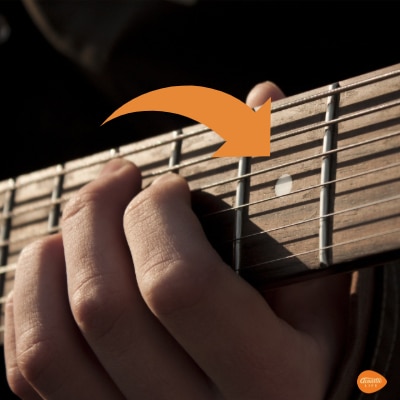
If you look at the neck of the guitar — and the side of the neck that faces you — you’ll notice little dots or markings embedded into the neck. These are called fret markers.
Fret markers help you find frets faster and, in turn, see the right guitar notes.
On most guitars, the fret markers are placed on the 3rd, 5th, 7th, 9th, and 12th frets.
If you ever lose your place on the fretboard, you can use the fret markers to guide you toward the guitar note you want to play.
Naturals vs. Sharps and Flats
Guitar notes that do not have sharps or flats attached to them are called naturals. Naturals within the musical alphabet are A, B, C, D, E, F, and G.
The notes are called naturals because they have no sharps or flats. As you try to find naturals on the fretboard, there are a few different rules that you can keep in mind
There are 2 frets between A and B, C and D, F and G, and G and A.
- This two-fret space is called a whole-step.
- You can also move a whole step not on a natural (ie. C# to D#).
There is one fret between B and C and E and F.
- This 1 fret space is called a half-step.
- Ex. the distance between C# and D is a half-step.
Finding Naturals on the Fretboard
For this exercise, you will find all of the naturals on the low E string (that’s the thickest one!).
Fortunately, we know that the low E string is natural. That means we have to move either a whole-step or half-step to get to the next natural.
If you remember the rules we laid out, there’s always going to be a half step between E and F
- You need to move a half step above E to play your first natural on the low E string.
- This means you’ll play F on the first fret of the low E string.
As you continue to move up the neck, just remember the rules we laid out earlier, and be sure to mind the half step between B and C!
Once you feel comfortable working on the low E string, I want you to try finding all the natural notes on the A string, the D string, the G string, and the B string.
As you look for the natural guitar notes, notice that the placement of the naturals changes depending on the strings you use.
Clarifying Sharps and Flats
We covered naturals, sharps, and flats when finding guitar notes on your fretboard. Now, I want to focus more on sharps and flats.
I’ve noticed in teaching beginners about guitar notes that it might take a few explanations to make an idea snap into focus.
Now that I’ve firmly established what natural notes are, we can think of sharps and flats as the space between natural notes.
Do you remember that whole step between A and B? Well, if you only move a half step (move in between two naturals), then you’ve found a sharp or flat!
Guitar Notes Exercise on the E String
Now that I’ve gone over naturals, sharps, and flats, I want to solidify the relationships between certain guitar notes.
Think of this exercise as a mental walkthrough of the fretboard to ensure you understand guitar notes effectively.
Guitar Notes E and F
Here’s a quick way we can move between the guitar notes E and F:
- There are no sharps or flats between E and F — they are two naturals separated by a half-step.
- This movement would be from an open string (E) to the first fret, or just one fret up from where an E note is.
Guitar Notes F and G
The relationship between the F and G guitar notes is standard.
- There is a whole step between the two notes.
- The movement from F to G is 2 frets, from the 1st fret on the E string to the 3rd fret on the E string.
These are just two examples of how you can better understand guitar notes and the relationships between each one.
Taking 10 Minutes Every Day to Get Better
Now that you have a better idea of guitar notes and how your knowledge can help your playing, perhaps you’re ready to take the next step in your guitar journey.
Do you remember the workshop I told you about earlier? Look, I won’t be offended if you can’t make it…but I’d love to see you there.
Watch this FREE guitar class for three secrets to learn guitar faster in just 10 minutes a day.
Very interesting info!Perfect just what I was searching for!
Great post. I am facing a couple of these problems.
Utterly pent subject matter, thankyou for entropy.
Thanks for another informative blog. Where else could I get that type of info written in such an ideal way? I’ve a project that I am just now working on, and I’ve been on the look out for such info.
Well I sincerely liked studying it. This subject provided by you is very constructive for good planning.
Wonderful goods from you, man. I’ve understand your stuff previous to and you’re just too fantastic. I really like what you’ve acquired here, certainly like what you’re stating and the way in which you say it. You make it enjoyable and you still care for to keep it smart. I cant wait to read much more from you. This is actually a great web site.
I believe you have observed some very interesting details , appreciate it for the post.
Way cool! Some very valid points! I appreciate you writing this write-up plus the rest of the site is really good.
great points altogether, you just received a emblem new reader. What would you recommend in regards to your put up that you simply made some days in the past? Any sure?
Hi, just required you to know I he added your site to my Google bookmarks due to your layout. But seriously, I believe your internet site has 1 in the freshest theme I??ve came across. It extremely helps make reading your blog significantly easier.
I like it whenever people come together and share opinions. Great site, stick with it!
Nice post. I was checking constantly this blog and I am impressed! Very useful info specially the last part 🙂 I care for such info a lot. I was looking for this particular info for a long time. Thank you and best of luck.
Very great article
Thanks for sharing it.
Thank you for sharing your insights
Appreciate it for helping out, fantastic information.
you have a great blog here! would you like to make some invite posts on my blog?
Hello there! Do you know if they make any plugins to protect against hackers? I’m kinda paranoid about losing everything I’ve worked hard on. Any recommendations?
I have read a few good stuff here. Certainly worth bookmarking for revisiting. I wonder how a lot attempt you put to create one of these wonderful informative web site.
Good day! I could have sworn I’ve been to this blog before but after browsing through some of the post I realized it’s new to me. Anyways, I’m definitely glad I found it and I’ll be bookmarking and checking back frequently!
Se você gosta de fazer compras online e quer pagar menos sem abrir mão da qualidade, o Cupom da Vez é a solução ideal!
I am so happy to read this. This is the kind of manual that needs to be given and not the accidental misinformation that is at the other blogs. Appreciate your sharing this greatest doc.
O Pix My Dollar é um aplicativo de microtarefas: você realiza atividades simples no celular e acumula recompensas, que podem ser convertidas em dinheiro.
I saw a lot of website but I think this one contains something extra in it in it
Good post but I was wondering if you could write a litte more on this topic? I’d be very grateful if you could elaborate a little bit more. Bless you!
There is clearly a bunch to realize about this. I believe you made certain good points in features also.
I’m really enjoying the design and layout of your site. It’s a very easy on the eyes which makes it much more enjoyable for me to come here and visit more often. Did you hire out a developer to create your theme? Outstanding work!
I conceive you have observed some very interesting points, thankyou for the post.
Very interesting subject , thanks for posting.
Cool blog! Is your theme custom made or did you download it from somewhere? A theme like yours with a few simple tweeks would really make my blog jump out. Please let me know where you got your theme. Appreciate it
I got what you intend,saved to fav, very decent site.
My brother suggested I might like this website. He was entirely right. This post truly made my day. You cann’t imagine simply how much time I had spent for this information! Thanks!
I am constantly invstigating online for posts that can facilitate me. Thanks!
I am often to running a blog and i actually recognize your content. The article has actually peaks my interest. I’m going to bookmark your website and keep checking for brand spanking new information.
Very interesting topic, thanks for posting. “If you have both feet planted on level ground, then the university has failed you.” by Robert F. Goheen.
Somebody essentially help to make critically posts I’d state. That is the first time I frequented your website page and so far? I amazed with the research you made to make this particular put up extraordinary. Excellent activity!
Nice post. I was checking constantly this blog and I’m impressed! Very helpful info particularly the last part 🙂 I care for such information a lot. I was looking for this certain information for a long time. Thank you and good luck.
I simply couldn’t leave your website prior to suggesting that I really loved the usual info an individual supply for your visitors? Is gonna be back frequently in order to inspect new posts.
Awsome site! I am loving it!! Will be back later to read some more. I am taking your feeds also.
I’m curious to find out what blog platform you have been utilizing? I’m experiencing some minor security problems with my latest blog and I’d like to find something more safeguarded. Do you have any solutions?
Precisely what I was looking for, regards for putting up.
Hey would you mind sharing which blog platform you’re using? I’m going to start my own blog in the near future but I’m having a hard time choosing between BlogEngine/Wordpress/B2evolution and Drupal. The reason I ask is because your design and style seems different then most blogs and I’m looking for something unique. P.S My apologies for being off-topic but I had to ask!
Those are yours alright! . We at least need to get these people stealing images to start blogging! They probably just did a image search and grabbed them. They look good though!
Hey! Would you mind if I share your blog with my zynga group? There’s a lot of folks that I think would really enjoy your content. Please let me know. Cheers
excellent post.Ne’er knew this, regards for letting me know.
With havin so much written content do you ever run into any problems of plagorism or copyright infringement? My website has a lot of completely unique content I’ve either created myself or outsourced but it appears a lot of it is popping it up all over the internet without my authorization. Do you know any ways to help stop content from being stolen? I’d genuinely appreciate it.
Thanks a lot for sharing this with all of us you really know what you’re talking about! Bookmarked. Please also visit my site =). We could have a link exchange arrangement between us!
great post, very informative. I wonder why the other experts of this sector do not notice this. You should continue your writing. I am sure, you’ve a great readers’ base already!
I want gathering utile info, this post has got me even more info! .
Awsome post and straight to the point. I don’t know if this is truly the best place to ask but do you people have any ideea where to hire some professional writers? Thanks in advance 🙂
As a Newbie, I am constantly browsing online for articles that can be of assistance to me. Thank you